Each year, Holocaust Memorial Day invites us to pause, to remember the six million Jewish people murdered in the Holocaust, alongside the millions of other victims of Nazi persecution and to reflect on the consequences of hatred, prejudice and indifference.
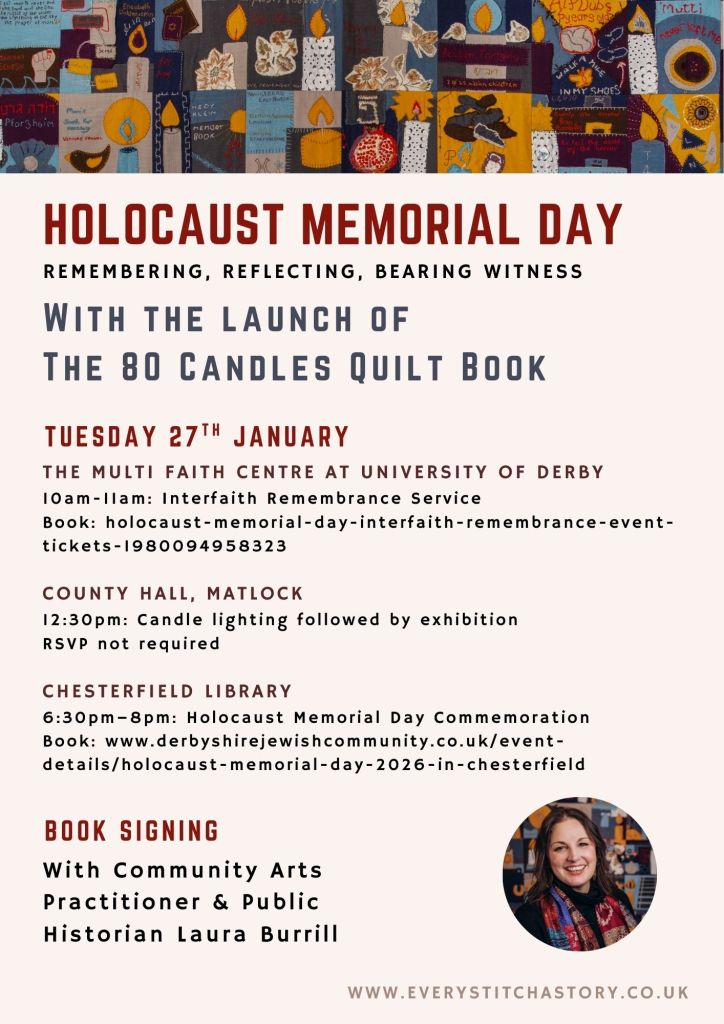
This year, I am honoured that The 80 Candles Quilt Book: Honouring Individual Lives through Collaborative Stitch will be launched as part of a series of Holocaust Memorial Day events across Derbyshire. While the book will be introduced and available for signing, these gatherings are first and foremost spaces of remembrance, reflection, and collective witness.
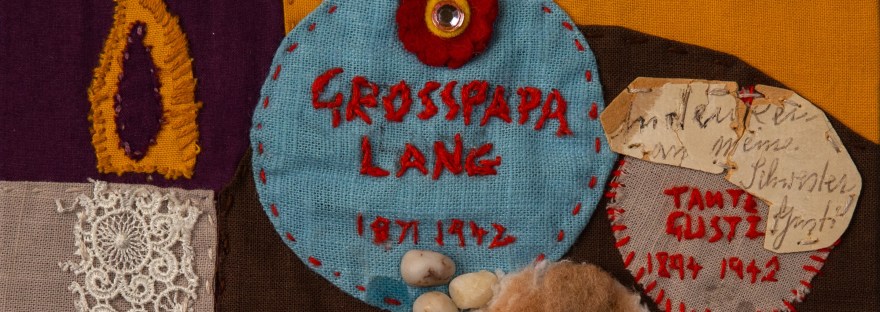
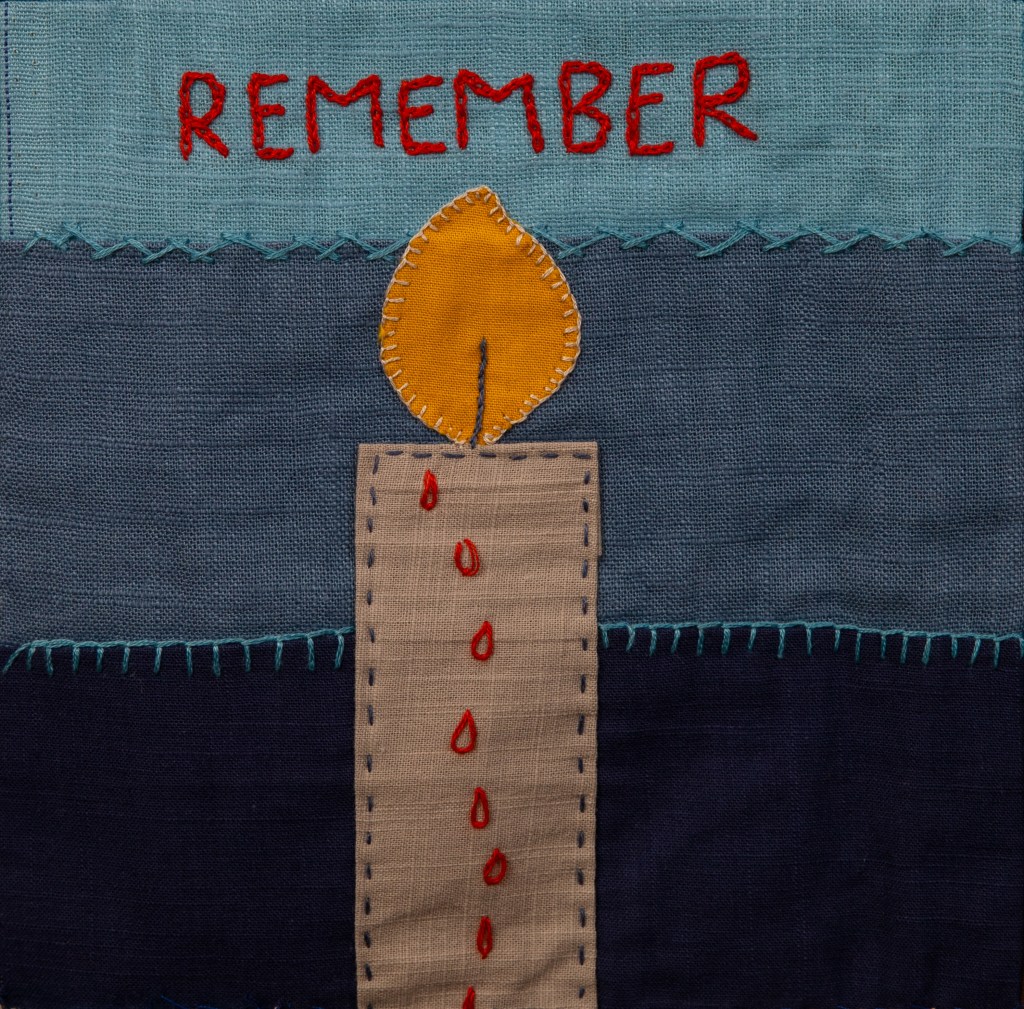
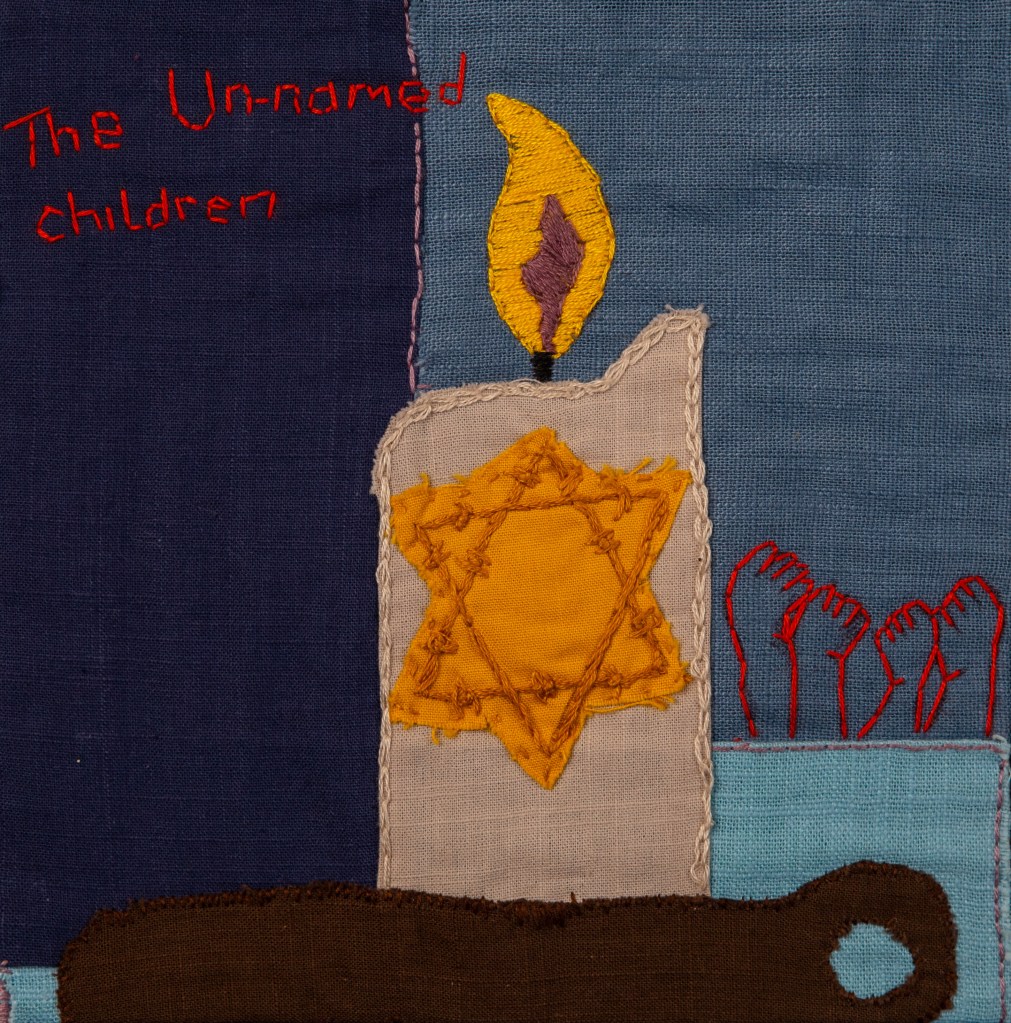
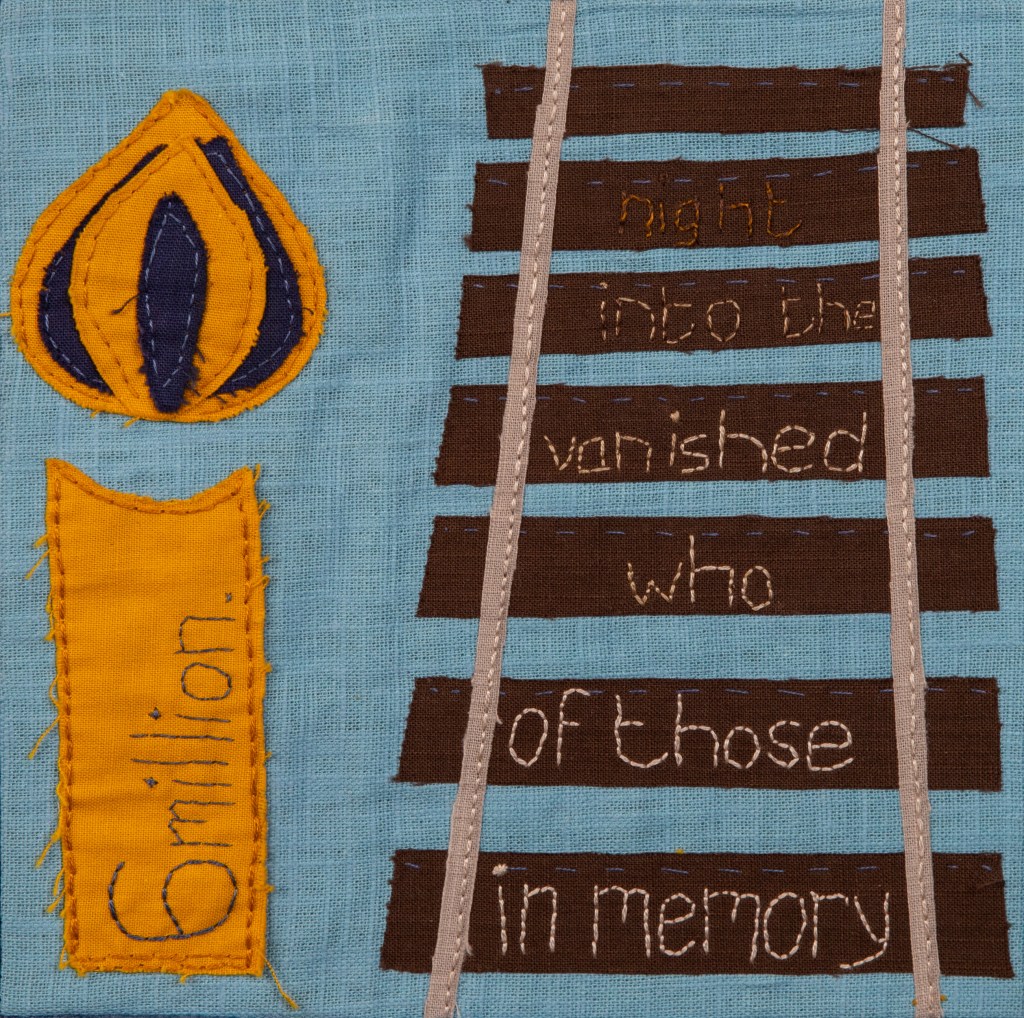
Walter Kammerling by Alice BurnsTo the children who died in the camps by Lisa MatthewsThe Undocumented by Janet Ireland
The 80 Candles Quilt Project
The 80 Candles Quilt began as a collaborative act of remembrance — a way of honouring individual lives through stitch, care, and shared commitment to memory. Each candle represents a life, a story, and a refusal to forget.
This book brings together those stitched contributions, ensuring that the stories behind them can continue to be shared, remembered, and honoured beyond the quilt itself. It exists not as an endpoint, but as a continuation of remembrance.
I am deeply grateful to everyone who has contributed to, supported, and shared in this project. The book is a testament to what can be held — and honoured — when memory is carried collectively.
Event Details
Derby
10:00am–11:00am Derby Interfaith Holocaust Remembrance Service Multi Faith Centre, University of Derby Kedleston Road, Derby, DE22 1GB
12:30pm arrival for a 1:00pm start Candle lighting followed by exhibition – Derbyshire County Council County Hall, Matlock, Derbyshire, DE4 3AG
An open public event centred on candle lighting and reflection. RSVP not required.
Chesterfield
6:30pm–8:00pm Holocaust Memorial Day Commemoration – Chesterfield Borough Council Featuring testimony via Zoom from Peter Summerfield BEM Chesterfield Library New Beetwell Street, Chesterfield, Derbyshire, S40 1QN
At each event, copies of The 80 Candles Quilt Book will be available and I will be signing books following the formal commemorations where appropriate. The signing is intended as an extension of remembrance, a quiet moment to honour the stories held within the pages.
Holocaust Memorial Day reminds us that remembrance is not passive. It is an active choice to listen, to learn and to carry stories forward. I hope you will be able to join us at one of these events as we remember, reflect, and bear witness together.
Trying to pick just one person to represent in a quilt in memorial to those affected by the Holocaust is daunting. As a champion for telling stories through the creation of textiles I knew I wanted to honor a fellow ‘sewist’, someone who had stitched something whilst in a concentration camp.
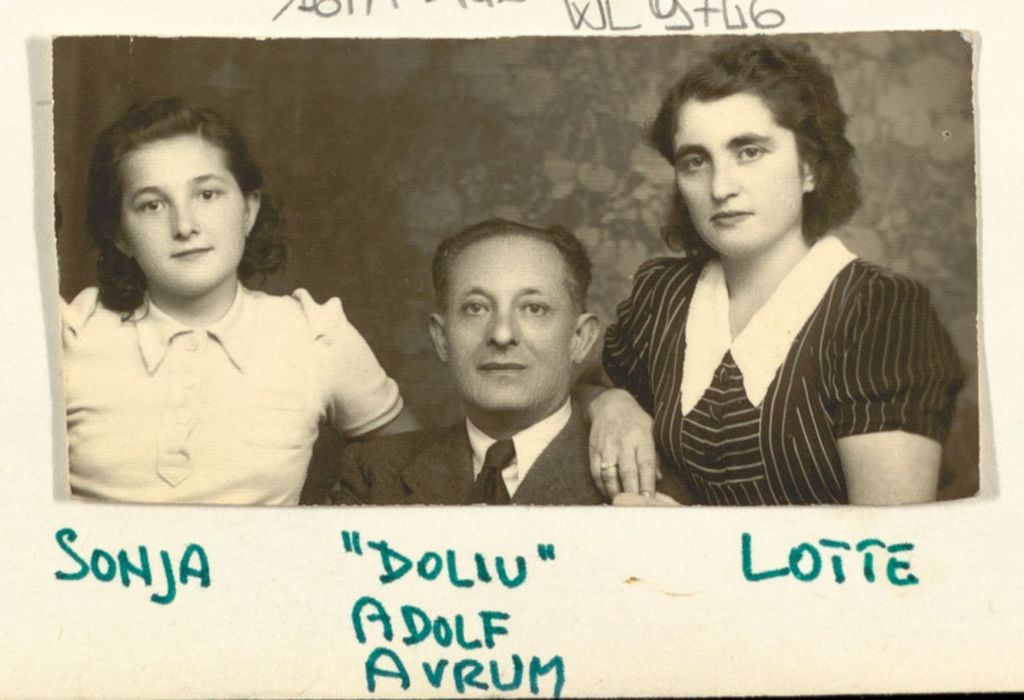
Meet Sonja Jaslowitz, a young German speaking, Jewish Romanian girl whose creative talent lives on through her poetry and embroidered belt.
Sonja’s story…
On 4th June 1942, Sonja Jaslowitz, together with her German speaking Jewish parents, Lotte and Adolf Jaslowitz, were deported to Cariera de Piatra Concentration and Camp.[1]
Sonja was just 15 years old. She left behind her home, a first floor flat owned by her grandmother, in the bustling town of Czernowitz, Romania. [2] Czernowitz had a large Jewish community, but as fascism rose in popularity across Romania, antisemitism increased. [3] Between 1941 and 1944 approximately three hundred thousand Jews and Roma perished in the Romanian administered region.[4]
Sonja and her family were sent eastward to a region that came to be known as Transnistria. Transnistria was a ‘holding’ or ‘containment’ place for deported Jews, a ‘dumping ground’ to await mass transfer across the Bug River.[5] The family spent time in the makeshift Cariera de Piatra concentration camp. Once a granite rock quarry, inmates found ‘shelter in wrecked guard and storage sheds that had been built partially into the rock’. [6] More than five hundred people were crammed into wooden barracks built to accommodate just eighteen. [7] From here they were sent to Obodovka Concentration Camp and then onto the Tiraspol ghetto. With limited documentation we can only imagine how Sonja and her parents managed to survive the brutal environment. Together they would have faced deprivation, starvation, dehydration and bitterly cold temperatures.
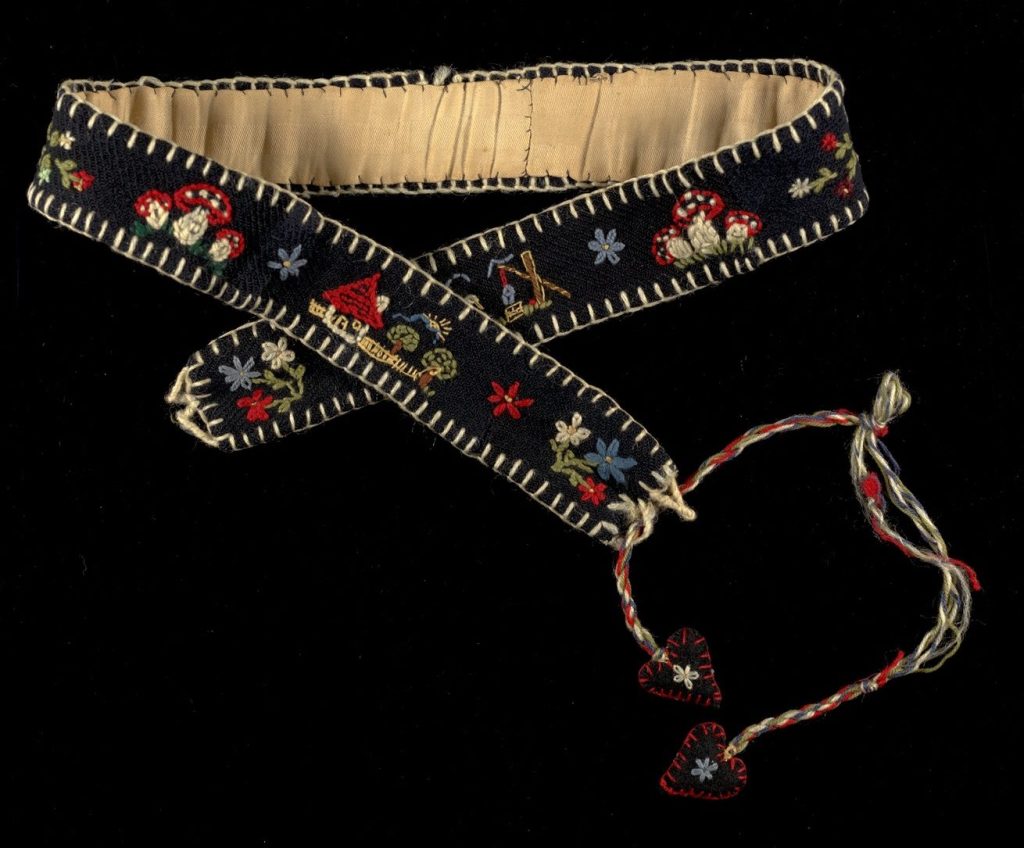
Amongst all this horror Sonja chose to create, and perhaps more remarkably some of her creations survived. These surviving acts of resistance include a black blanket-stitched belt embroidered with whimsical flowers, mushrooms and quaint scenes of houses with picket fences, trees, fluffy clouds and sunshine; and a body of poetry written in German, Romanian and French. Composed in the camps and ghettos of Transnistria her poetry gives us a glimpse of the girl she was, thoughtful, observant, resourceful, sarcastic, courageous, defiant.
Using simple verses and metaphorical phrases Sonja conveys her deeply felt emotional state of pain and longing whilst painting a picture of her surroundings. She gives agency to hope, nurturing her confidence and mental energy in order to survive.
Sonja and her parents were liberated in 1944 and repatriated to the Romanian capital, Bucharest. Here she typed an illustrated some of her poems. Sadly, she was killed during the shelling of Bucharest, April 1944. Collateral damage victim of shrapnel from Allied bombs intended for German-controlled oil installation near Romanian capital.[10] Sonja’s father died shortly afterwards having contracted tuberculosis in the ghetto. Her mother moved to England, bringing with her Sonja’s creative works.
How would Sonja feel about her work being shared? Did she create privately for herself or intentionally to share her story? Was she determined to document her experience, exercising her own limited agency within the confines of Nazi rule, or simply filling time?
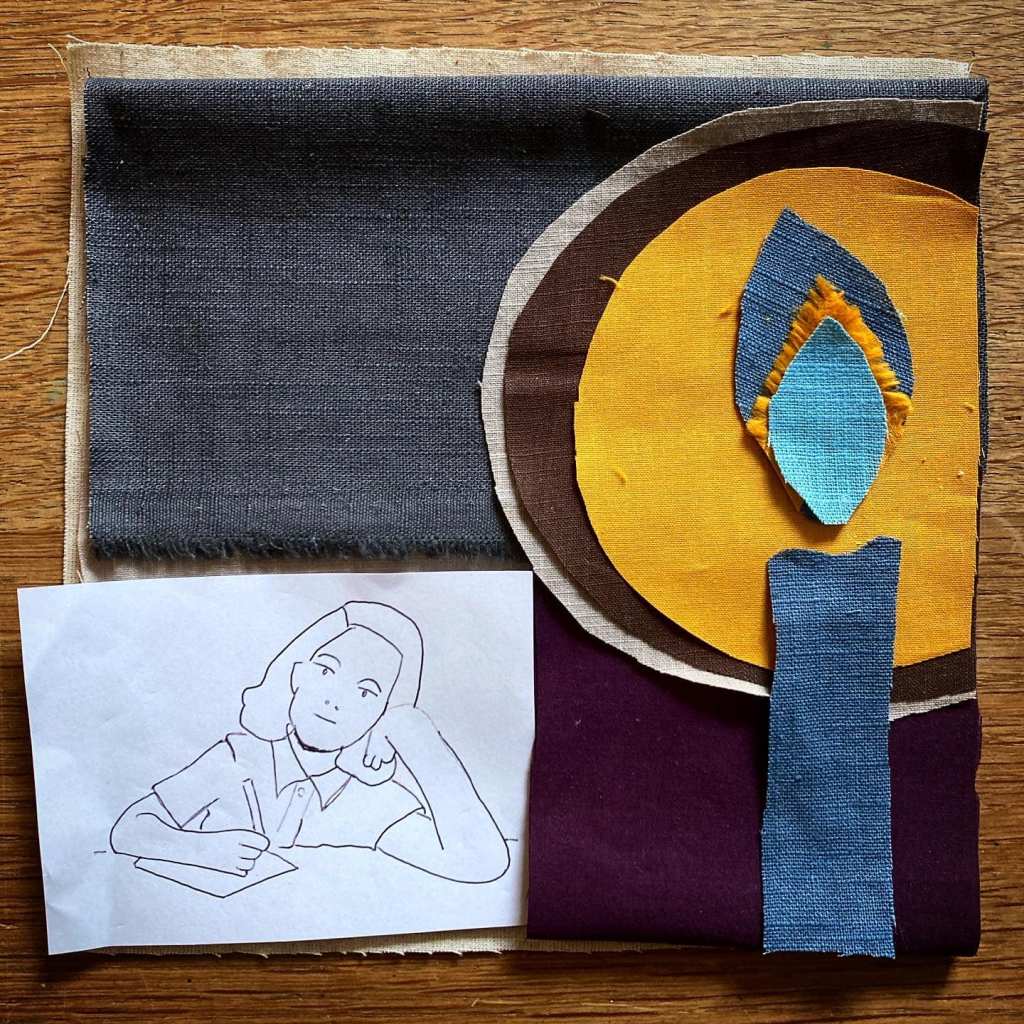
There is a vulnerability in creating and being creative, works set free into the world can easily be dismissed, ignored, criticized or misunderstood. But there is also power in creating art; the power to tell a story and share ones inner most self for others to see. It provides space to contemplate and regulate emotion and room for play and experimentation. Sonja’s embroidered belt is what drew me to find out more about her, I was sure an object of such whimsy and beauty created in such horror had a story to tell. I wonder what Sonja would think of the square I am dedicating to her?
Square one, work in progress. ‘Remembering Sonja Jaslowitz’, Laura Burrill, linen on calico.
[5] Hirsch, K, Spitzer, L, ‘Small Acts of Repair: The Unclaimed Legacy of the Romanian Holocaust’, Journal of Literature and Trauma Studies, Volume 4, No 1-2, Spring/Fall, 2015 p.13-42p25
[6] Hirsch, K, Spitzer, L, ‘Small Acts of Repair: The Unclaimed Legacy of the Romanian Holocaust’, Journal of Literature and Trauma Studies, Volume 4, No 1-2, Spring/Fall, 2015 p.13-42P.27
[9] From poem ‘Longing’, S. Jaslowitz (Translated) Hirsch, K, Spitzer, L, ‘Small Acts of Repair: The Unclaimed Legacy of the Romanian Holocaust’, Journal of Literature and Trauma Studies, Volume 4, No 1-2, Spring/Fall, 2015 p.13-42, p.29.
[10] Hirsch, K, Spitzer, L, ‘Small Acts of Repair: The Unclaimed Legacy of the Romanian Holocaust’, Journal of Literature and Trauma Studies, Volume 4, No 1-2, Spring/Fall, 2015 p.13-42, p.14.


 Every Stitch A Story