Blog

Brand New Community Stitch Project… The Brailsford Bayeux

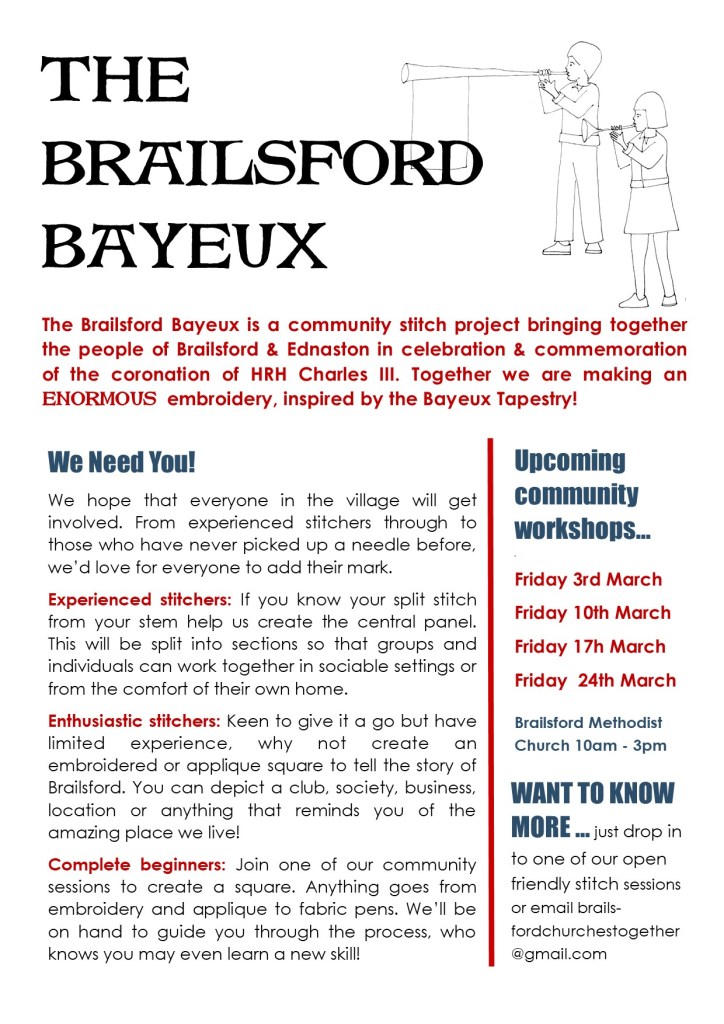
I’ve been dying to share this news for weeks; admin done, materials sourced,
and plans made I can now finally share my latest commission. The Brailsford
Bayeux; a community stitch project bringing together the people of Brailsford
& Ednaston in celebration and commemoration of the coronation of HRH
Charles III. Working together with the Brailsford & Ednaston Churches
Together Group and local residents we are making an ENORMOUS embroidery
inspired by the Bayeux Tapestry. This is by far the most ambitious project I
have worked on to date and once finished will, we hope, will be well in excess
of 5 meters!

The coronation of HRH Charles III will take place at Westminster Abbey on
Saturday 6th May 2023. The ceremony will see His Majesty King
Charles crown alongside the Queen Consort. The Brailsford Bayeux will
commemorate this historic moment in time, depicting a procession of
well-wishers, made up of community organisations and groups from the locality
who travel from important local landmarks and community spaces.

The Bayeux tapestry, which is actually a large embroidery and not a
tapestry, acts as our inspiration. The original narrative hanging was
commissioned by William the Conqueror’s half-brother and tells the story of the
events surrounding the conquest of England by the Duke of Normandy. The
original is made of 9 panels of linen joined together, in total it is a
whopping 68.3 meters long and 70cm wide. Our narrative hanging will not be
quite this big but with the help of parishioners we hope to make it as large as
possible.

The original hanging was crafted by three groups of workers using 4 basic
stitches (stem, chain, split and laid or Bayeux stitch) in 10 colours of wool
thread. We hope that everyone in the village will get involved, from
experienced stitchers through to those who have never picked up a needle
before, everyone can add their mark. We’ve got open stich sessions planned
throughout March at the Brailsford Methodist Church, see below for details.
Plus, as always, I’m open to running sessions with community groups so if you
live in Brailsford or Ednaston and would like to get involved let us know!
Derby Women History Makers Exhibition

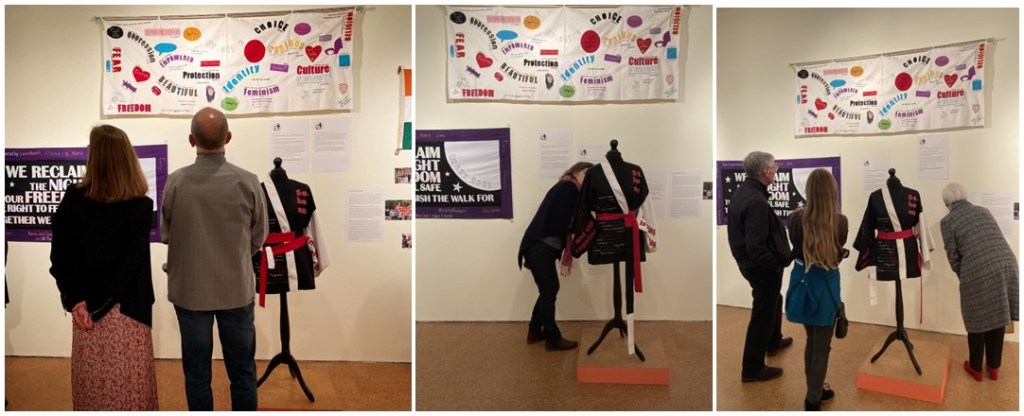
Absolute pinch myself moment! Three of my textile works are on display at Derby Museums & Art Gallery as part of their Derbyshire Women History Makers Exhibition. Veiled Voices 2020, #SayHerName and the collaboratively produced Reclaim the Night banner are centre stage in the project lab area.

The whole exhibition is awesome, but I can’t deny I got a kick from seeing the three pieces on display. It was especially poignant to see people interact with them and witness important conversations being generated by the subjects they discuss.

The exhibition runs through until the end of February and is free to enter.

Sunshine and Sangster’s

Well, it feels that spring has finally sprung and whilst I welcome the sunshine and a chance to warm myself like a lizard in the sun, ladies of previous centuries would have been aghast at the very thought.

During the 19th century women, especially those of the upper classes, actively sought a pale complexion. Such a pallor distinguished them from those that laboured outdoors, reinforcing status and visually portraying their position as a woman of genteel inactivity, a women of class. As such protection of the skin from the sun was of vital importance and so the parasol was an essential and stylish accessory.

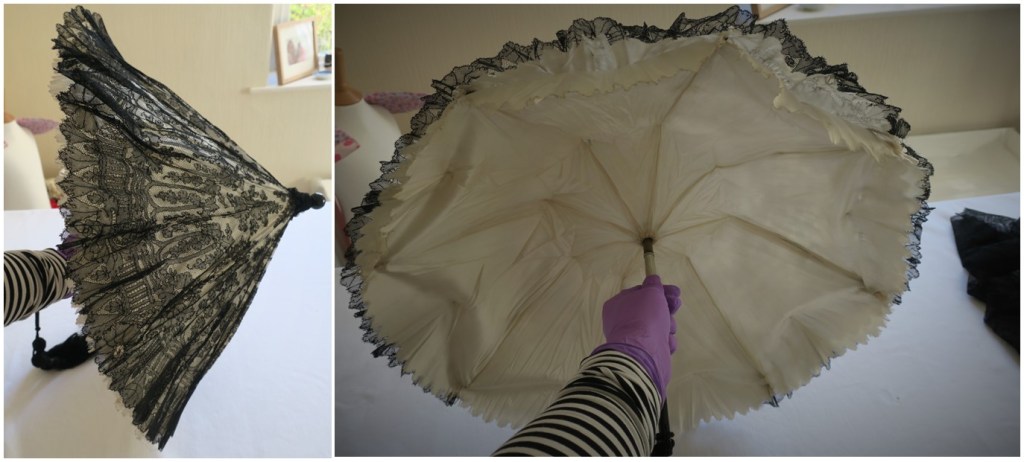
In recent months I’ve had the pleasure of archiving two beautiful late 19th century parasols. The first a striking ‘Carriage Parasol’ of cream silk and black lace (c. 1860-1880).  The design of this parasol is ingenious, halfway down the stick, the parasol has a hinge allowing it to be neatly folded into a more manageable size. Carriage parasols came into use in the early nineteenth century and were made popular by Queen Victorian in the 1840s as she enjoyed parading in an open carriage.

Ladies ‘Carriage Parasol’. Cream silk and black lace (c. 1860s-1880s)

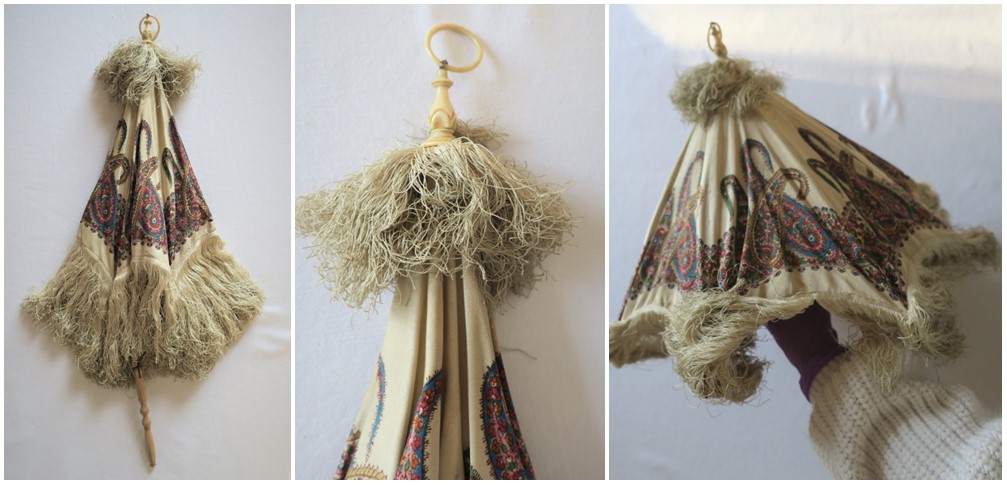
Children were also expected to protect their complexion and this little paisley parasol (c.1890s) made by W. & J. Sangster Umbrella Makers is a rather beautiful example. The canopy is of printed silk crepe, edged with cream fringing which rather wonderfully had little bits of grass, seeds and debris lodged in it (now delicately removed). Whilst little girls were expected to be little women, clearly this child had space to play and enjoy the outdoors. The intricate paisley pattern is based on a repeat of three large, clustered tear drops in blue, pink, green, burgundy and brown and printed onto a cream base. The ‘ferrule’, possibly ivory, has a loop to enable the child to carry it.

Child’s Sangster Parasol c.1890s

W. & J. Sangster Umbrella Makers were a prominent London based firm established in the late 18th century, initially a walking stick and cane makers they later expanded into umbrellas, parasols and sunshades in the early 19th century. Their advertising can be found in numerous publications; interestingly these adverts not only tell us about fashions of the day but give indications of an ever expanding trade and industry network alongside a glimpse into attitudes regarding an expanding world and the availability of the new, novel and strange.

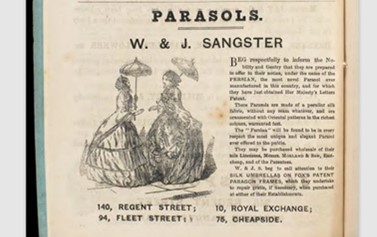
An advert from 1856 refers to  the launch of their ‘PERSIAN’, ‘the most novel Parasol ever manufactured in this country’, ‘made of peculiar silk… ornamented with oriental patterns’. Perhaps paisley!
Image from Dickens, C.; Little Dorrit, (London: Charles Bradbury & Evans, London. 1856) June VII, pp. 12.
 

The Soldiers Embroidery Industry

Over recent weeks I’ve been focusing on cataloguing, a process I absolutely love as it provides chance to revisit objects and indulge in a little extra research.

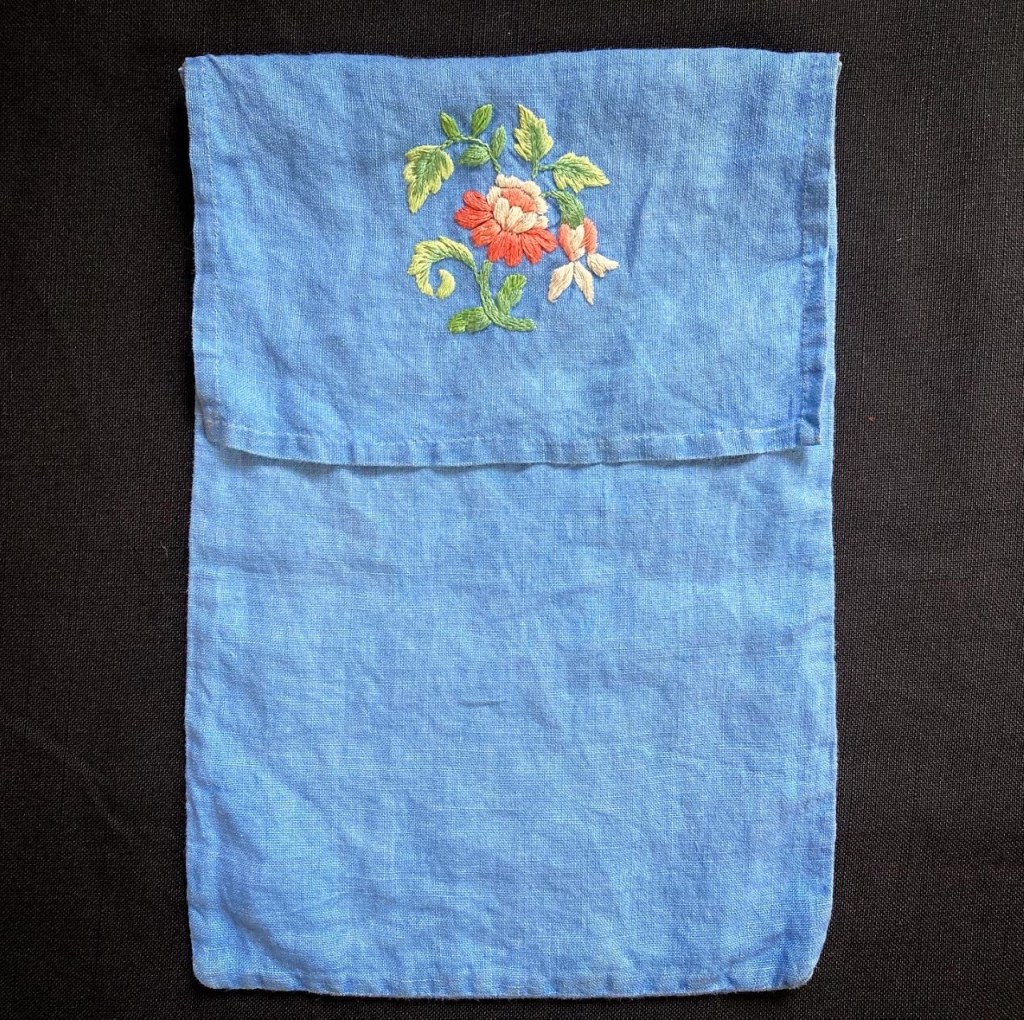
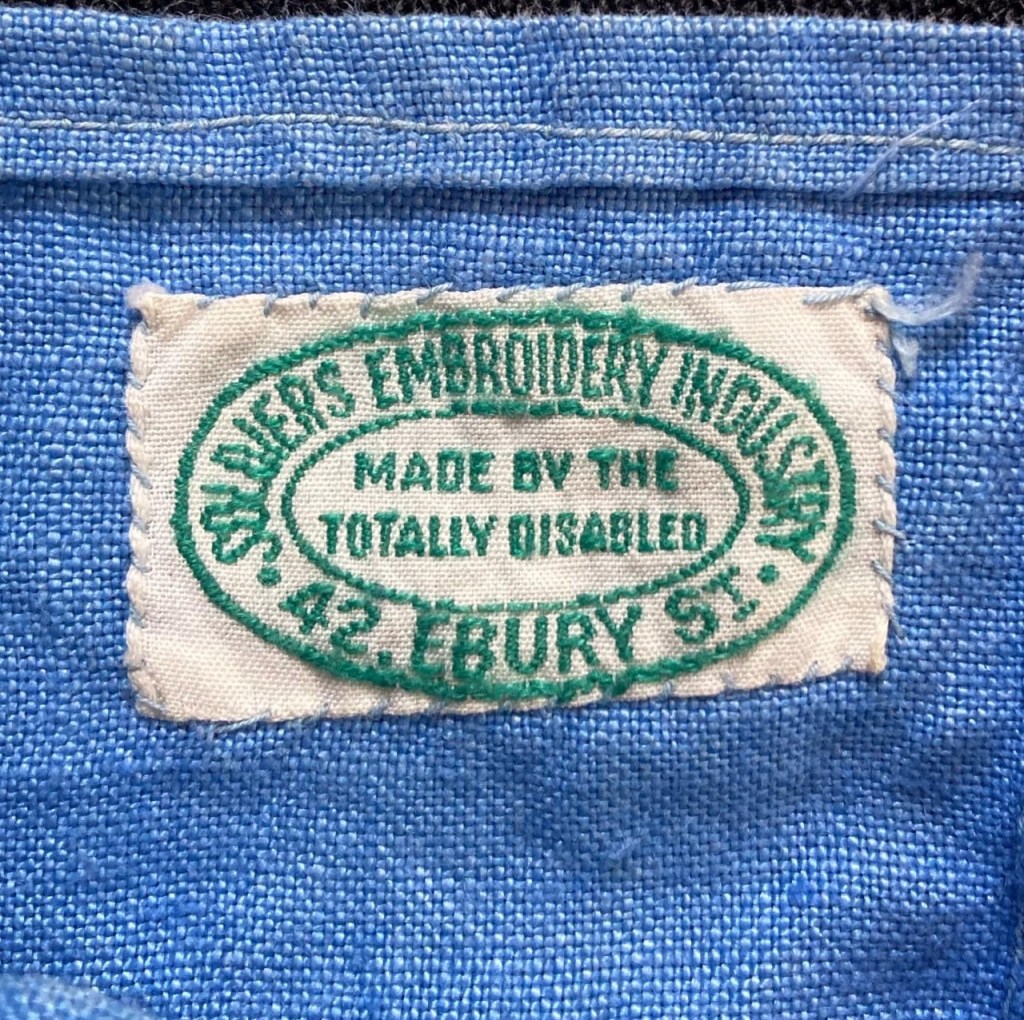
This unassuming little blue linen envelope pouch, embroidered with its solitary sprig of peach and orange blooms, is by far an away one of my favourite objects I’ve ever had the pleasure of examining, documenting and archiving.

It was made by the Soldiers Embroidery Industry, a charitable organisation set up after the First World War to aid the rehabilitation of severely injured, bedridden and shell-shocked soldiers. With over a quarter of a million combatants returning from the war with debilitating and permanently life changing injuries and only limited support available from the state, multiple charitable organisations set up quickly to fill the gap. The Disabled Soldiers Embroidery Industry was one of the most high profile, spearheaded by Ernest Thesiger it was supported by royalty, aristocracy and the middle classes enabling them to visually display their ‘Christian values’.

Alongside saleable items, soldiers created large scale pieces for royalty (including an altar piece for the private chapel at Buckingham Palace), churches and exhibitions. In 1933 the Daily Mirror reported that Princess Elizabeth received a gift of ‘a small blue bag embroidered in petit point, with her initial “E” and a crown on the front of it’, from a disabled soldier at a bazar, I wonder if it looked anything like this one?