Blog

Workshop Announcement: Introduction to the art of slow stitching

I’m super excited to share that I’m running a short series of workshops in June and July sharing the art of slow stitching.

The mindful art of slow stitching has increasingly become a regular part of my textile praxis over recent years. For me it has been a private, explorative process, focusing on process rather than outcome. As a self-confessed perfectionist, addicted to the daily hustle, outcomes and productivity, it has challenged me to view my textiles work through a new lens. Guided by the Japanese philosophy of ‘Wabi-Sabi’ my slow stitching practice is focused on searching for beauty in imperfection, embracing impermanence whilst revelling in slowness and process. Slow stitching is now an activity I reach for on a daily basis, it slows my mind, soothes my need to create when I have only minutes for textiles practice (because let’s face it life is busy!) and as it turns out has resulted in beautiful miniature pieces of textiles art that are full of meaning. So now I’d love to share this beautiful form of textile creation with others.

I’ve seen first-hand through the various community textiles projects I have facilitated that hand stitching has the ability to heal, sooth and provide an outlet for people to express themselves; even when they don’t consider themselves creative. It requires simple skills, which can easily be picked up, limited materials and equipment and takes up barely any space. So why don’t you join me? Classes will be small and sociable with all materials and equipment provided. Plus, there’ll be refreshments of tea, coffee and biscuits… well you can’t be creative without sustenance!

Drawing on traditional hand sewing textile practices from around the world I’ll guide participants through the process of repurposing unwanted and discarded textile fragments, utilising the most basic of hand sewing stitches, to create beautiful pieces of textiles art to treasure and share.

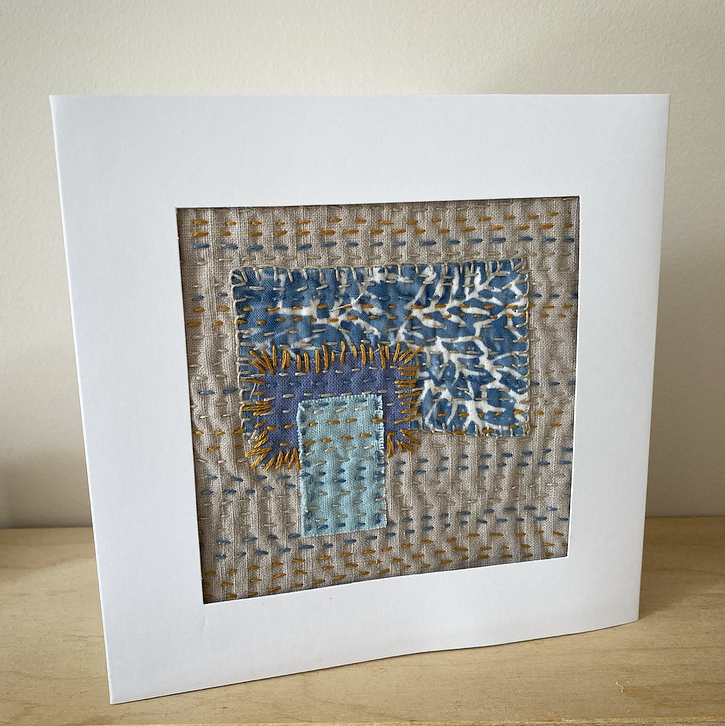
Introduction to Slow Stitching: Textile Collage Card

Friday 30th June: Brailsford Methodist Church 9.30am – 1pm

Join me to discover the basics of slow stitching and create your very own beautiful textile collage card.

£25 includes all materials and equipment.

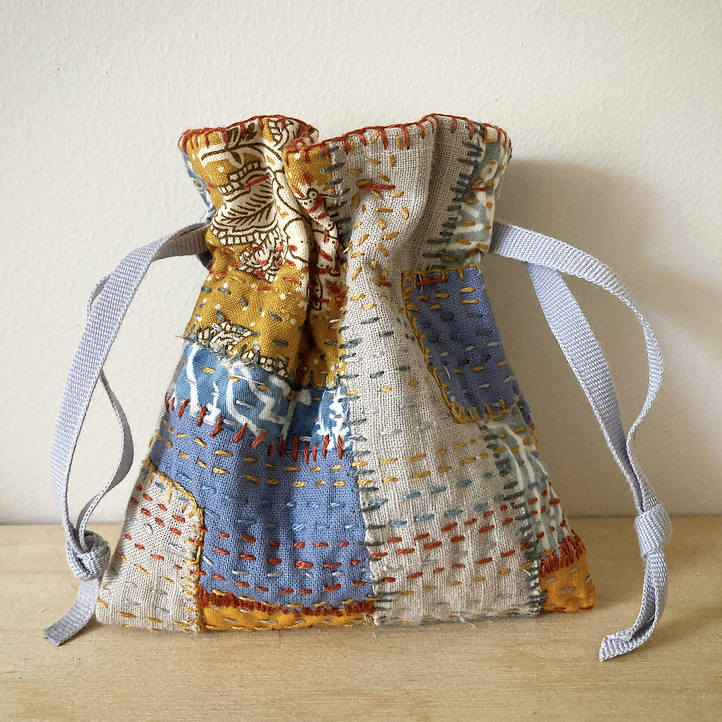
Slow Stitching Workshop: Textile Collage Bag

Friday 7th & 14th July: Brailsford Methodist Church 9.30am – 1pm

Join me to discover the art of slow stitching and create your very own beautiful textile drawstring bag. This larger project runs over two sessions. The first workshop will focus on exploring composition and the basics of slow stitching, the second on bag construction and potential variations.

£50 includes all materials and equipment.

This series of classes can be booked as a course package for the discounted rate of £60.
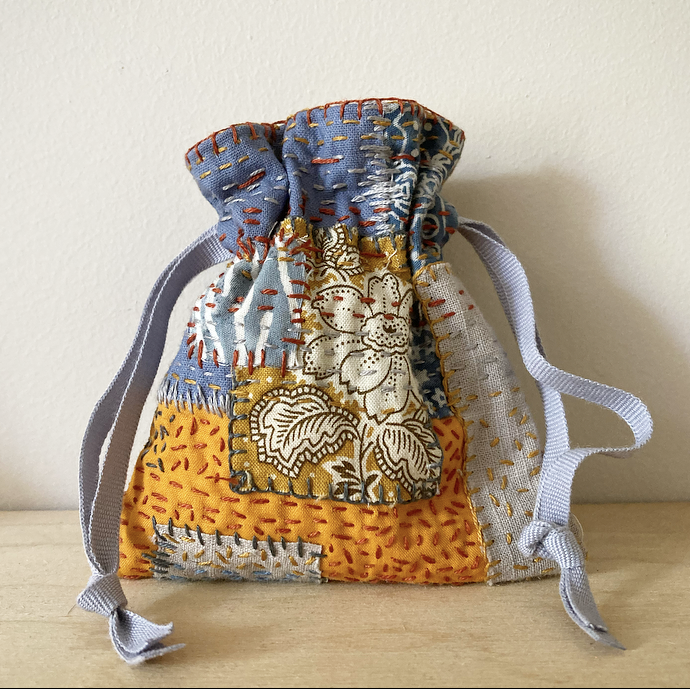
No needlework experience is necessary for any of the classes, I’ll be on hand to guide you through the simple stitches and processes to help you create beautiful and meaningful pieces of textile art. We’ll be using reclaimed, recycled and vintage fabrics from my collection of textiles amassed from across the world (doesn’t everyone buy fabric when they travel?). But I encourage participants to bring along scraps of fabrics that are special to them to incorporate into their work or use as inspiration.

BOOKING ESSENTIAL.  To book or for more information please contact me on Laura_Burrill@outlook.com
Brailsford Bayeux update…

We are incredibly lucky in Brailsford to have a couple who used to work in tv and radio news, they have kindly captured the process and development of the project for us.

A sneak peek at the final stages of The Brailsford Bayeux… no spoilers though, you’ll have to wait until the grand unveiling ceremony on Saturday 29th April, All Saints Church, Brailsford!

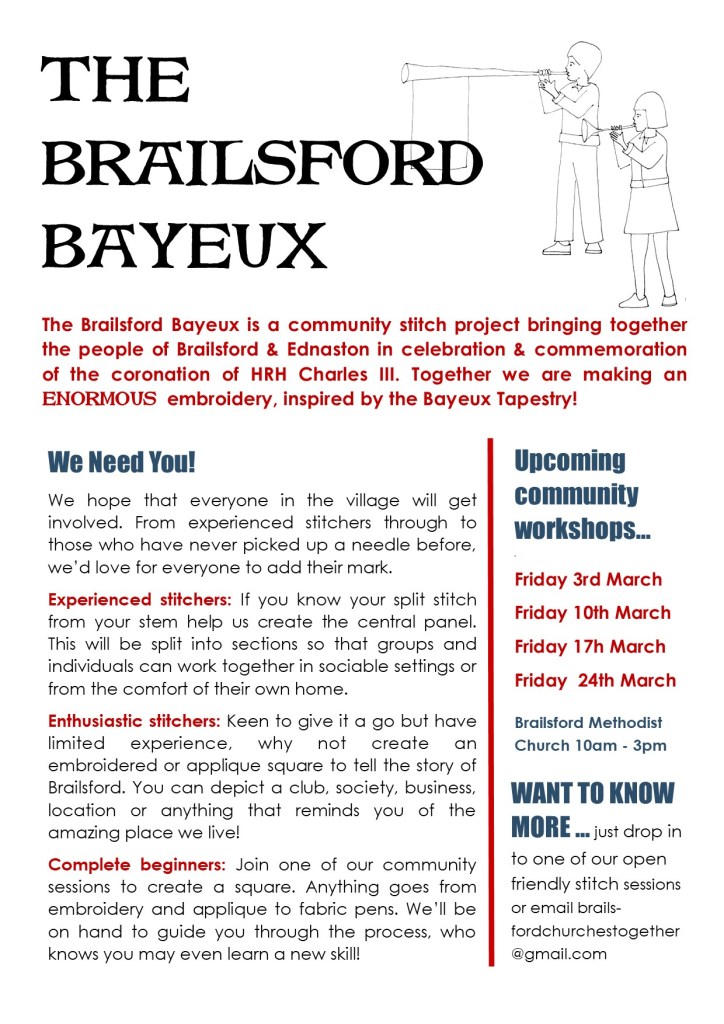
Brand New Community Stitch Project… The Brailsford Bayeux

I’ve been dying to share this news for weeks; admin done, materials sourced,
and plans made I can now finally share my latest commission. The Brailsford
Bayeux; a community stitch project bringing together the people of Brailsford
& Ednaston in celebration and commemoration of the coronation of HRH
Charles III. Working together with the Brailsford & Ednaston Churches
Together Group and local residents we are making an ENORMOUS embroidery
inspired by the Bayeux Tapestry. This is by far the most ambitious project I
have worked on to date and once finished will, we hope, will be well in excess
of 5 meters!

The coronation of HRH Charles III will take place at Westminster Abbey on
Saturday 6th May 2023. The ceremony will see His Majesty King
Charles crown alongside the Queen Consort. The Brailsford Bayeux will
commemorate this historic moment in time, depicting a procession of
well-wishers, made up of community organisations and groups from the locality
who travel from important local landmarks and community spaces.

The Bayeux tapestry, which is actually a large embroidery and not a
tapestry, acts as our inspiration. The original narrative hanging was
commissioned by William the Conqueror’s half-brother and tells the story of the
events surrounding the conquest of England by the Duke of Normandy. The
original is made of 9 panels of linen joined together, in total it is a
whopping 68.3 meters long and 70cm wide. Our narrative hanging will not be
quite this big but with the help of parishioners we hope to make it as large as
possible.

The original hanging was crafted by three groups of workers using 4 basic
stitches (stem, chain, split and laid or Bayeux stitch) in 10 colours of wool
thread. We hope that everyone in the village will get involved, from
experienced stitchers through to those who have never picked up a needle
before, everyone can add their mark. We’ve got open stich sessions planned
throughout March at the Brailsford Methodist Church, see below for details.
Plus, as always, I’m open to running sessions with community groups so if you
live in Brailsford or Ednaston and would like to get involved let us know!

Derby Women History Makers Exhibition

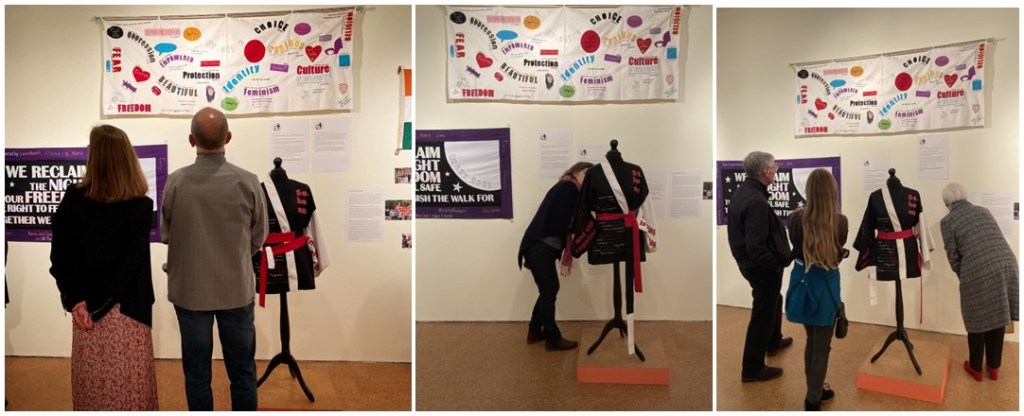
Absolute pinch myself moment! Three of my textile works are on display at Derby Museums & Art Gallery as part of their Derbyshire Women History Makers Exhibition. Veiled Voices 2020, #SayHerName and the collaboratively produced Reclaim the Night banner are centre stage in the project lab area.

The whole exhibition is awesome, but I can’t deny I got a kick from seeing the three pieces on display. It was especially poignant to see people interact with them and witness important conversations being generated by the subjects they discuss.

The exhibition runs through until the end of February and is free to enter.

Sunshine and Sangster’s

Well, it feels that spring has finally sprung and whilst I welcome the sunshine and a chance to warm myself like a lizard in the sun, ladies of previous centuries would have been aghast at the very thought.

During the 19th century women, especially those of the upper classes, actively sought a pale complexion. Such a pallor distinguished them from those that laboured outdoors, reinforcing status and visually portraying their position as a woman of genteel inactivity, a women of class. As such protection of the skin from the sun was of vital importance and so the parasol was an essential and stylish accessory.

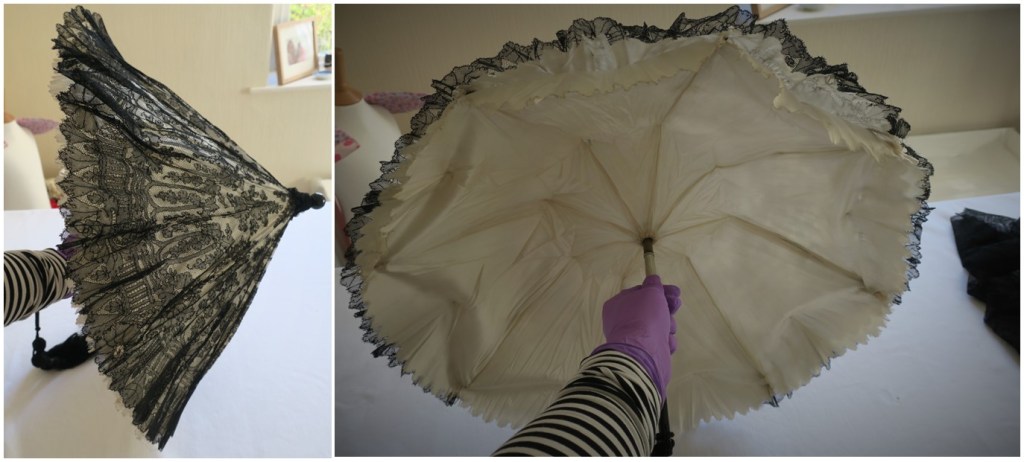
In recent months I’ve had the pleasure of archiving two beautiful late 19th century parasols. The first a striking ‘Carriage Parasol’ of cream silk and black lace (c. 1860-1880).  The design of this parasol is ingenious, halfway down the stick, the parasol has a hinge allowing it to be neatly folded into a more manageable size. Carriage parasols came into use in the early nineteenth century and were made popular by Queen Victorian in the 1840s as she enjoyed parading in an open carriage.

Ladies ‘Carriage Parasol’. Cream silk and black lace (c. 1860s-1880s)

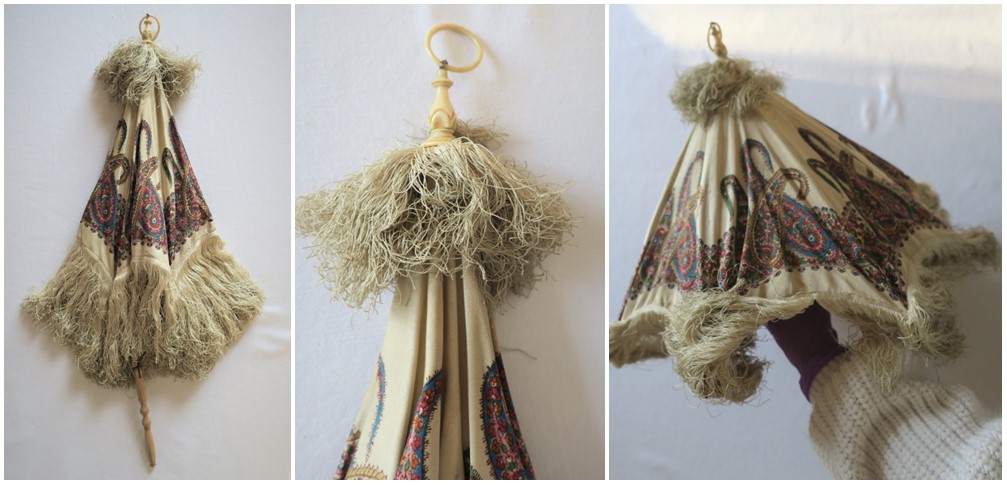
Children were also expected to protect their complexion and this little paisley parasol (c.1890s) made by W. & J. Sangster Umbrella Makers is a rather beautiful example. The canopy is of printed silk crepe, edged with cream fringing which rather wonderfully had little bits of grass, seeds and debris lodged in it (now delicately removed). Whilst little girls were expected to be little women, clearly this child had space to play and enjoy the outdoors. The intricate paisley pattern is based on a repeat of three large, clustered tear drops in blue, pink, green, burgundy and brown and printed onto a cream base. The ‘ferrule’, possibly ivory, has a loop to enable the child to carry it.

Child’s Sangster Parasol c.1890s

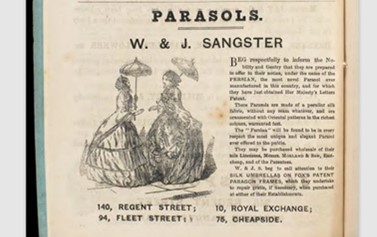
W. & J. Sangster Umbrella Makers were a prominent London based firm established in the late 18th century, initially a walking stick and cane makers they later expanded into umbrellas, parasols and sunshades in the early 19th century. Their advertising can be found in numerous publications; interestingly these adverts not only tell us about fashions of the day but give indications of an ever expanding trade and industry network alongside a glimpse into attitudes regarding an expanding world and the availability of the new, novel and strange.

An advert from 1856 refers to  the launch of their ‘PERSIAN’, ‘the most novel Parasol ever manufactured in this country’, ‘made of peculiar silk… ornamented with oriental patterns’. Perhaps paisley!
Image from Dickens, C.; Little Dorrit, (London: Charles Bradbury & Evans, London. 1856) June VII, pp. 12.